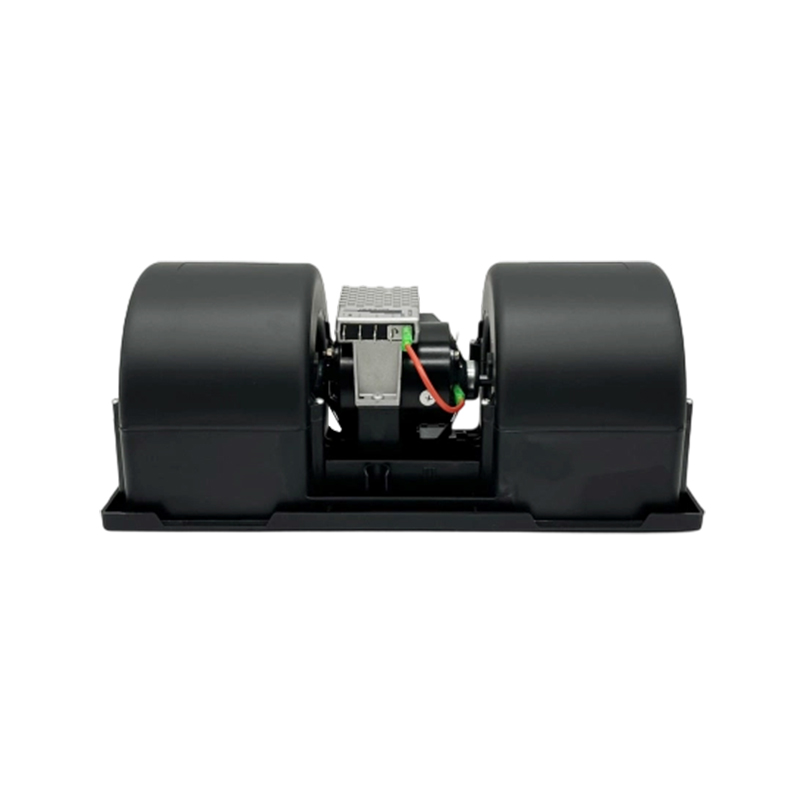
Why Coach HVAC Blower Systems Are Fundamentally Different from Passenger Car Units
Zhejiang Shuolang Motor Parts Co., Ltd. supplies blower motors across automotive, commercial vehicle, and specialty segments, and the demands placed on a coach air conditioning system cooling blower represent some of the most challenging operating conditions in the entire product category — demanding engineering approaches that differ substantially from passenger car HVAC design.
The core difference is duty cycle. A passenger car blower motor operates intermittently — cooling or heating the cabin during commutes and journeys, then sitting idle. A long-haul coach blower runs continuously for 8 to 16 hours per day, maintaining cabin temperature across a passenger load that generates its own substantial heat and moisture. At sustained full-load operation, motor winding temperatures in a coach blower routinely reach 90 – 110 °C, compared to 55 – 70 °C peaks in equivalent passenger car units. This thermal environment demands motor insulation rated to Class F (155 °C) or Class H (180 °C) rather than the Class B (130 °C) standard acceptable in automotive HVAC.
Physical scale compounds the engineering challenge. Coach HVAC systems — whether rooftop units on intercity buses, under-floor systems on luxury coaches, or ceiling-mounted cassette units on airport shuttles — move vastly greater air volumes than any passenger car system. Blower motors in this segment are typically rated at 150 W to 600 W, versus the 30 – 80 W range of standard automotive units, and operate centrifugal impellers with diameters of 200 – 400 mm turning at 800 – 2,200 RPM under continuous load.
Coach Blower Motor Configurations: Rooftop, Under-Floor, and Evaporator Unit Designs
Coach air conditioning systems are installed in several distinct architectural configurations, each imposing different requirements on the Coach Air Conditioning System Cooling Blower and necessitating separate motor specifications rather than a single universal unit.
Rooftop Integrated Units
Rooftop A/C units — dominant on city buses, school buses, and mid-range intercity coaches — house the evaporator, condenser, compressor, and blower assembly in a single roofline enclosure. The blower motor in this configuration must tolerate direct solar radiation heating the surrounding enclosure to ambient temperatures well above 60 °C before the A/C system is even running. IP54 or higher ingress protection is mandatory, as rooftop units are directly exposed to rain, road spray redirected by aerodynamic turbulence, and high-pressure water during bus wash cycles. Motor shaft sealing at the impeller end is particularly critical — water entry along the shaft destroys bearing lubrication within hours under continuous rotation.
Under-Floor Evaporator Systems
Luxury coaches and long-distance intercity buses increasingly use under-floor or rear-bay evaporator systems that distribute conditioned air through the floor or overhead ducts. Blower motors in under-floor positions face severe vibration from road surface irregularities transmitted directly through the chassis — vibration profiles that can reach 15 – 30 g peak acceleration on unpaved or poorly maintained routes. Mounting systems for these motors use anti-vibration isolators rated to ISO 10816-6 severity zone D, and motor internal construction must avoid components — brush spring retainers, end-cap fasteners, capacitors — that can work loose under sustained vibration.
Ceiling Cassette and Distributed Duct Systems
Airport transfer buses, shuttle coaches, and large tour vehicles often use multiple ceiling-mounted cassette blower units distributed along the cabin length. Each cassette contains an independent blower motor, typically in the 150 – 250 W range, all controlled from a central HVAC management system. The key specification concern here is matched airflow performance across all units: variation in blower motor output between cassettes creates uneven cabin temperature distribution and triggers passenger complaints concentrated in rear-row seating. Replacement motors for distributed cassette systems must be sourced to tightly controlled performance tolerances — airflow variation of more than ±5 % between units is detectable by passengers in a quiet coach cabin.
Electrical Supply Variations and Motor Compatibility in Coach Applications
Coach HVAC electrical architecture is significantly more complex than passenger car systems, and electrical mismatches account for a disproportionate share of premature blower motor failures in this segment. Shuolang's engineering team validates every coach blower motor against the specific electrical environment of its target application — a step that generic automotive parts suppliers frequently omit.
Key electrical variables that determine motor compatibility in coach applications:
- 24 V vs. 12 V supply: Heavy-duty coaches — including most vehicles built on Yutong, King Long, Higer, Zhongtong, and Volvo bus platforms — use a 24 V electrical system for the main chassis and HVAC circuits. Installing a 12 V motor on a 24 V supply burns out the armature winding within minutes. Conversely, a 24 V motor on a 12 V supply produces approximately one-quarter of rated output, resulting in severely inadequate cabin cooling. Always confirm system voltage from the coach chassis specification sheet, not from visual inspection of the battery configuration.
- AC-powered blower systems: Some coach HVAC systems — particularly stand-alone rooftop units designed for shore power connection at terminals — operate the blower motor from 220 V or 380 V AC rather than the vehicle's DC bus. These single-phase or three-phase induction motor units are entirely incompatible with DC replacement motors regardless of physical dimensions. The motor nameplate voltage and frequency rating must be matched exactly to the HVAC unit's power supply specification.
- Inverter-driven variable speed control: Premium coach HVAC systems use variable frequency drives (VFDs) or EC (electronically commutated) motor technology to modulate blower speed continuously based on cabin temperature demand. EC motors in these applications incorporate permanent magnet rotors and integrated control electronics — they are not interchangeable with conventional brush-type or induction motor units and must be replaced with exact-specification EC equivalents that match the control signal protocol of the HVAC management system.
- Dual-voltage auxiliary systems: Some coach designs use a 12 V auxiliary circuit for HVAC controls and displays while powering the blower motors from the main 24 V bus. Harness connectors in these vehicles may physically accept either voltage level — confirming the supply voltage with a multimeter at the motor connector before installation is a non-negotiable step, not an optional precaution.
Maintenance Intervals and Replacement Planning for Fleet Coach Operators
For coach fleet operators running scheduled service routes, unplanned HVAC blower failures are among the most disruptive maintenance events — a coach with failed cabin cooling is typically taken out of passenger service immediately, creating schedule gaps and passenger compensation obligations. Structured replacement planning based on realistic service life estimates eliminates the majority of unplanned failures.
Realistic service life benchmarks for coach blower motors vary significantly by application quality and operating environment:
- Brush-type DC motors in rooftop units: 3,000 – 6,000 operating hours under normal conditions. At 10 hours per day of A/C operation, this corresponds to a 1 – 1.5 year replacement cycle for year-round operation in hot climates. High ambient temperatures above 40 °C reduce this range by 20 – 30 %.
- Brushless DC and EC motors: 15,000 – 25,000 operating hours when properly specified and installed. The substantially higher upfront cost is typically recovered within the first replacement cycle avoided compared to brush-type equivalents.
- Bearing inspection at 2,000-hour intervals: Regardless of motor type, bearing condition should be assessed acoustically (listening for rumble or intermittent noise at low speed) and thermally (infrared check of bearing housings under load) at regular service intervals. Early bearing degradation detected at inspection adds months of safe service life compared to running to failure.
- Filter and airway cleaning: Coach HVAC air filters operating in urban environments accumulate dust, carbon particulate, and biological material at rates that can halve effective filter life compared to highway operation. Clogged filters force blower motors to work against elevated static pressure continuously — the single most preventable cause of premature motor failure in fleet coach applications.
Fleet procurement teams planning scheduled replacement programs will find our full range of heavy-duty and standard-duty units at Coach Air Conditioning System Cooling Blower — with application data, voltage ratings, and performance specifications documented for each unit to support accurate fleet maintenance planning.



 русский
 Español
 عربى
عربى Türk
Türk